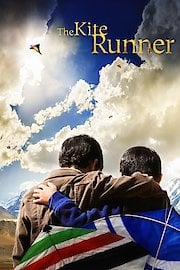
The Kite Runner

The Kite Runner

Add to Favorites
PG-13
| | 2 hr 7 min | Drama

"The Kite Runner" is about the Afghanistan conflict: Its characters demonstrate the human-side of the devastation. It is an absorbing film and will have the intelligent movie enthusiast fully absorbed. It does not just provide a tale: it is intensely thought-provoking. The film begins with several children kite-flying. They are flying kites in the metropolitan area of Kabul. The date is 1978. The era is well before the Taliban, the United States involvement; Russian involvement and uprising. Amir played by Zekiria Ebrahimi joins in with a number of other children - all male in flying the kites. It appears that at times the kites are dancing; other times they are moving in such a way that they look as if in conflict with one another. It appears one kite is attempting to break the other kite's staid mobility or string with that of its own string. The friend of Amir is Hassan played by actor Ahmad Khan Mahmoodzada. Hassan is the son of the family's domestic help Ali. The domestic employee has been associated with the family for a very long tenure. The servant, suffice it to say is as much a family member as anyone in the household. Hassan is reputed as the neighborhood's best kite runner. He instinctively knows when it is a kite will come back down again and awaits its arrival.

The boys in the film live in a thriving, vital Metropolitan area: that is, it has not yet been ruined by the devastation of military conflict. Amir's Dad, Baba played by the actor Homayoun Ershadi is highly academic; a smart man. It is apparent that he is fond of both of the boys; and is a very kind man.

The movie employs a bully in the neighborhood. His name is Assef. Assef is very jealous of Amir's kite as well as Amir's level of kite-flying talent. One day, which determines course of many of the film's characters, the bully Assef and his rough group hunt down Hassan and attack him severely. Amir witnesses this attack on Hassan however quietly leaves the scene.

Amir secretly feels guilty about witnessing the attack on Hassan. This guilt turns into passionate upset. He tries everything to get rid of his inward reaction: even throwing fruit at Hassan. However, as to the fruit-throwing scene Hassan shows no reaction. Next: Amir attempts to make Hassan look like someone who steals. He does this by framing him and planting tell-tale signs of thievery. Hassan provides Baba a false confession with reference to being a thief. Nevertheless, Baba forgives Hassan. Ali, Hassan's father is insistent that he and his son leave the household of Baba even though Baba does not prefer it.

The film from that point progresses elaborating on past memories and what is current. Conclusively, if Amir had not made his mistake with regard to Hassan when just a boy they would all have been gathered in California where the adult Amir is currently.

The movie is the work based on the best selling novel by Khaled Hosseini. Screenwriter David Benioff and Marc Forster, its Director have been successful in making a movie that steps around the lack of connection we frequently experience when it is that a storyline moves from one era to the next; or from past memories to current. The story though is one unit; and is woven well with the lifetimes of its characters.

There is a scene wherein Amir and his Dad; the latter now elderly and in poor health make the acquaintance of a one time powerful man: an Afghanistan General along with his daughter Soraya played by actress Atossa Leoni. Amir and Soraya fall in love at first sight. However, proper etiquette is in order. Another one of the movie's best scenes is where the two older men are in discussion about the futures of their two offspring.

Homayoun Ershadi is again Amir's father. You believe Amir's father to have a deep-seated goodness about his person. This is believable since his face is etched with a kind countenance; his eyes are very soulful. In fact, it is believable enough that the audience member cannot even conceive of the actor ever thinking about anything unkindly or immoral.

The film's scenes with regard to the nations of Pakistan and Afghanistan during the beginning of the Millennium are very suspenseful; incorporated with emotional depth. One iconic scene involves a game of soccer wherein the game's audience: all male and uncharacteristically quiet is being watched by militaristic-type personnel with firearms.

The movie touches you; from a great emotional depth. This is because the storyline is so very absorbing. It is absorbing in the way it defines the character's futures. Each character becomes significant to the movie viewer. The film is food for thought.

Generally, we have been confined to merely hearing about the Afghanistan conflict; however, the film exposes us to some of its people and on a very personal individual basis.

The film is performed mainly in English. There are some scenes with Persian or Dari. Dari is an Afghanistan dialect pertinent to Farsi. However, such scenes do not confuse an English-speaking only audience.

The actors' performances specifically Hassan and Amir as little boys are very realistic and in turn immensely intense. Suffice it to say: the children's acting ability with respect to the two boys is so good that adult actors may be easily humbled or otherwise jealous. In example, Hassan, again played by Ahmad Khan Mahmoodzada is particularly convincing with regard to his facial expressions. He makes use of very convincing expressions of sadness.

The kite flying scenes are very successful. It is not wrong to say there are effects used to entertain the audience with regard to the inventiveness of the scenes. Nevertheless, the kites are there as representations of free-spiritedness. It is not a secret what thrill the kites in the sky provide for the persons flying the kites. Certainly, those of us who practiced flying a kite as a kid; remember the thrill and fun of the activity: thus the scenes are something the movie audience can easily relate.

There is a basic dissimilarity though between Amir (kite flyer) and Hassan (kite runner). Hassan's wisdom in knowing what must go up must eventually come down is reasonably affected in his mournful facial expressions.

The film is described as awesome by many film buffs. It is a move by Marc Forster. Marc Forster is also responsible for the films: "Monster's Ball" (2001); "Finding Neverland" (2004), "Stay" (in 2005) and lastly, "Stranger Than Fiction" (2006). Forster makes very good films; however as far as intensity most film critics agree "The Kite Runner" parallels "Monster's Ball". It brings home the point: that each person we meet in our lives come from various situations and is not just a number inside of a military conflict.

The cast of the movie are as follows:

The child Amir: Actor Zekiria Ebrahimi; Amir: Khalid Abdalla The child Hassan: Ahmad Khan Mahmoodzada Baba: Homayoun Ershadi Ali: Nabi Tanha Assef Abdul: Salam Yusoufzai Youngish Assef: Elham Ehsas

The film is by Marc Forster. It is written by David Benioff and is based on a novel written by Khaled Hosseini. It is presented in Dari and English. It runs for around two hours. It is distributed by Dreamworks/Paramount Classics.

|More
Stars
Khalid Abdalla, Homayoun Ershadi, Zekiria Ebrahimi, Shaun Toub, Said Taghmaoui
Director
Marc Forster
Language
English
News for The Kite Runner
Add to Favorites
Review The Kite Runner
Add to Favorites
Loading
Video Clips for The Kite Runner
Add to Favorites