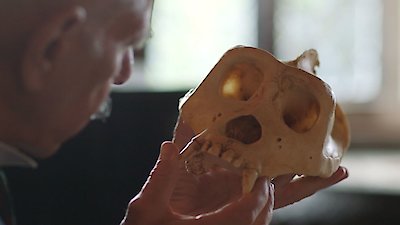
History's Greatest Hoaxes Season 1 Episode 5 Piltdown Man
- November 17, 2016
- 44 min
-
(8)
History's Greatest Hoaxes is a television show that explores some of the most audacious and elaborate schemes of frauds and con artists throughout history. In season one, episode five, titled "Piltdown Man," the show delves into the story of one of the greatest scientific hoaxes of the 20th century.
The episode begins by introducing viewers to one of the most significant discoveries in human evolution, the Piltdown Man. In 1912, an amateur archaeologist named Charles Dawson claims to have unearthed a skull fragment and jawbone from a gravel pit in Piltdown, England. The skull fragment bears human-like features, while the jawbone resembles that of an ape, leading archaeologists to believe that they had found the missing evolutionary link between humans and apes.
The discovery caused a sensation in the scientific community, and Piltdown Man quickly became a prominent figure in textbooks around the world. For almost 40 years, Piltdown Man was believed to be a vital piece of evidence in the theory of human evolution.
However, the episode reveals that the discovery was a clever forgery, and the skull fragment and jawbone were the work of a skilled hoaxer. The show presents evidence and testimonials from experts in the field, including scientists and historians, who have spent years unraveling the mystery behind the Piltdown Man hoax.
The episode uncovers the identity of the hoaxer, who is revealed to be a British lawyer and amateur geologist named Charles Dawson. Dawson had a reputation for being a collector of archaeological artifacts, and the episode argues that he was motivated by the desire for fame and recognition in the scientific community.
Through a combination of skillful forgery and deception, Dawson convinced his contemporaries of the authenticity of the Piltdown Man, despite several red flags that were raised over the years. The episode explores some of the inconsistencies and anomalies in the Piltdown Man story, including the fact that no comparable fossils or archaeological artifacts have been found in the area.
The Piltdown Man hoax was eventually exposed in 1953, thanks to the efforts of a group of scientists who were suspicious of the skull fragment's authenticity. The episode describes how, after extensive scientific testing, it was revealed that the skull fragment was only several hundred years old and did not belong to a prehistoric ancestor of modern humans.
The episode concludes by looking at the impact that the Piltdown Man hoax had on the scientific community and the field of human evolution. The forgery set back research on the human evolutionary timeline, as scientists spent decades trying to reconcile the inconsistencies and anomalies in the Piltdown Man story. The episode highlights the importance of skeptical inquiry and scientific rigor when evaluating scientific claims and the need for independent verification of scientific findings.
Overall, the "Piltdown Man" episode of History's Greatest Hoaxes is a fascinating exploration of one of the most elaborate and significant scientific hoaxes in history. The episode offers a compelling narrative that walks viewers through the entire lifecycle of the hoax, from the discovery to the eventual exposure of the fraud. Through interviews with experts and archival footage, the episode provides an engaging and thought-provoking look at the Piltdown Man hoax, its impact on the scientific community, and the lessons that can be learned from this intricate deception.