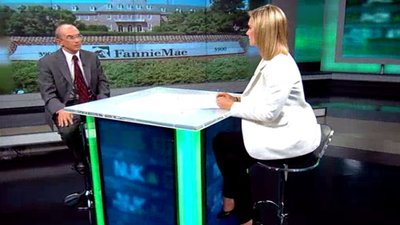
Boom Bust Season 1 Episode 187 Arnold Kling On Mortgage Finance and Bryan Caplan On Government Coercion
- TV-PG
- September 3, 2014
In this episode of Boom Bust, hosts Sara Montes de Oca and Brent Jabbour invite two experts, Arnold Kling and Bryan Caplan, to discuss two important economic issues. First, they delve into the world of mortgage finance with Kling, who is a scholar and author specializing in this area. He explores the problems with the current system and offers insights into potential solutions that could benefit both lenders and borrowers.
Kling argues that the traditional mortgage finance model is flawed and has created significant risks for both borrowers and lenders. He explains that the existing system relies too heavily on securitization, which enables financial institutions to bundle and sell loans to investors, but also creates complex and opaque structures that can be difficult to understand and analyze. Additionally, Kling believes that the current system does not adequately incentivize lenders to fully evaluate the creditworthiness of borrowers, which contributes to high default rates and other problems.
To address these issues, Kling proposes a new model for mortgage finance that he calls the "Kling Hypothetical." This model would emphasize simplicity and transparency, enabling borrowers and lenders to better understand how mortgage loans work and reducing the risks associated with securitization. Additionally, Kling's model would encourage lenders to conduct more thorough credit evaluations of borrowers, which could improve overall loan quality and reduce default rates.
Next, Montes de Oca and Jabbour turn to Bryan Caplan, an economist and professor at George Mason University, to discuss the role of government coercion in modern society. Caplan argues that coercion is necessary in some cases, but that it is often overused and can have negative consequences for individuals and society as a whole.
Caplan examines various examples of government coercion, including taxation, regulation, and criminal law enforcement. He acknowledges that some level of coercion is necessary to maintain social order and protect individuals from harm, but he also believes that too much coercion can infringe on individual rights and stifle economic growth and innovation.
Ultimately, Caplan argues that limiting government coercion is critical for ensuring individual freedom, promoting economic prosperity, and preserving a healthy civil society. He suggests a variety of strategies for reducing and mitigating the negative impacts of government coercion, such as decentralizing power, reducing regulatory burdens, and promoting market-oriented solutions to social problems.
Overall, episode 187 of Boom Bust offers a thought-provoking discussion of two key economic issues: mortgage finance and government coercion. With insights from experts Kling and Caplan, viewers can gain a deeper understanding of the challenges and opportunities facing our economy today.