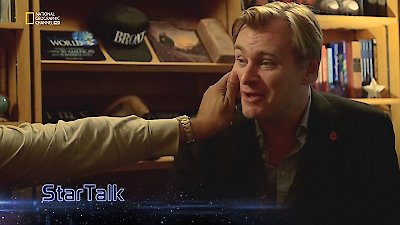
StarTalk Season 1 Episode 2 Christopher Nolan
- April 27, 2015
-
7.7 (46)
StarTalk is a talk show which takes the audiences on a journey of the universe and its mysteries. In season 1, episode 2, StarTalk host Neil deGrasse Tyson interviews Christopher Nolan, the filmmaker, who directed Inception, Interstellar, and the Dark Knight trilogy. The episode is entitled 'Christopher Nolan.'
The show begins with the introduction of Christopher Nolan's background and his work in films. Neil deGrasse Tyson talks about how Christopher Nolan seamlessly blends science-fiction with contemporary human stories, which has made his films unique and appealing to all. Nolan is known to incorporate scientific facts into his films, and Tyson is interested in diving deeper into this subject.
Neil deGrasse Tyson starts off by discussing the impact of black holes in Nolan's 'Interstellar' and Nolan's perspective in interpreting them in the movie. He also talks about how the perception of time differs in the movie. To Tyson, Nolan's films are expressionistic and contain realistic physics, which he states is an intriguing combination. He asks Nolan about his interest in science and how it influences his filmmaking. Nolan mentions how the science-fiction genre is an excellent medium to explore the complex universe without the limitations of reality.
The conversation takes a turn towards how black holes are perceived that science, too, has its limitations. Nolan believes that when it comes to science-fiction, it can be informed by science, and at times, it's left to imagination. When making Interstellar, Nolan consulted renowned physicist Kip Thorne to develop a better understanding of black holes and their anomalies. Thorne's explanation of the wormhole theory intrigued Nolan and inspired the creation of the plot for the movie.
The show gets more interesting as the discussion veers towards time travel, which has been a central theme in Nolan's movies. Neil deGrasse Tyson questions whether we can travel in time and mentions Stephen Hawking's views of time travel. Hawking believed that time travel is possible. He suggests that it can be done by using a wormhole or black hole to travel across space-time. Joey Diaz, a comic actress and musician also guest stars on the show and joins the discussion on time travel.
The discussion moves towards whether films can alter the reality of science or whether people's obsession with science fiction is changing the way people perceive science. Nolan believes that while films are often used as sources of entertainment, they can have an extensive reach when it comes to educating people about scientific concepts.
In the episode, Neil deGrasse Tyson also asks Nolan about his understanding of the human mind and perception, which is often seen in his films. Nolan discusses how the human mind perceives reality subjectively, and how understanding this has influenced his approach to filmmaking.
Towards the end of the show, Tyson and Nolan talk about the importance of science education and its impact on society. Nolan expresses his concerns about the lack of investment in science education in countries across the globe, emphasizing that the sciences are fundamental to our society as a whole.
Overall, StarTalk season 1 episode 2 with Christopher Nolan is a fascinating journey into the world of science and film. The show explores how science-fiction has taken on a life of its own in Nolan's films, the importance of scientific education, and how imagination can expand our understanding of the universe. It offers lots to those who are passionate about science, film and entertainment.
