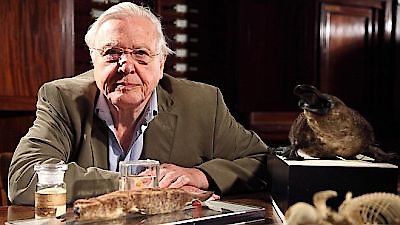
David Attenborough's Natural Curiosities Season 1 Episode 2 A Curious Hoax?
- TV-PG
- February 5, 2013
- 22 min
-
8.1 (51)
David Attenborough's Natural Curiosities is a captivating television series that explores some of the most peculiar stories from the world of animals. In the second episode of season one, titled "A Curious Hoax?," viewers follow Attenborough as he delves into the fascinating world of mimicry.
Mimicry is a common phenomenon among animals, in which a species imitates another in order to protect themselves from predators or gain a competitive advantage. In this episode, Attenborough examines two curious cases of mimicry that have long baffled the scientific community.
The first case revolves around the humble hoverfly, a small insect that resembles a bee in appearance. Despite not possessing a sting or any venom, the hoverfly has evolved to mimic the appearance, coloration, and even the movements of a bee. Attenborough explains how this mimicry helps the hoverfly to avoid predators that mistake it for a dangerous bee, allowing it to freely roam and forage for food.
However, the story of the hoverfly becomes even more intriguing when Attenborough introduces the idea of Batesian mimicry - a form of mimicry where a harmless species mimics a harmful one. According to Attenborough, the hoverfly's bee-like appearance is a perfect example of Batesian mimicry, and scientists have long debated whether the hoverfly is a genuine example of the phenomenon or just a curious hoax.
The second case of mimicry that Attenborough explores is that of the lyrebird, a bird renowned for its extraordinary mimicking abilities. Attenborough takes the viewers deep into the Australian forest to witness the various sounds that the lyrebird can make, including sounds of car alarms, chainsaws, and even human voices. He explains how the lyrebird uses its mimicking abilities to attract mates and defend its territory from other lyrebirds.
Attenborough then turns the story of the lyrebird on its head by introducing the idea of a different type of mimicry - where the mimic is not trying to protect itself but is instead using mimicry for deception and trickery. He introduces the concept of the 'mimic octopus,' a species that has evolved to mimic the appearance of other marine animals, allowing it to easily catch prey and avoid predators.
Throughout the episode, Attenborough brilliantly weaves together these peculiar yet fascinating stories of mimicry, highlighting the many ways that animals have evolved to adapt and survive in their respective environments. With his wealth of knowledge and expertise, Attenborough expertly explains the science behind each curious case of mimicry, making it easy for viewers to understand and appreciate the complexity of the animal world.
With stunning visuals and engaging narration, David Attenborough's Natural Curiosities season one episode two, "A Curious Hoax?," is a must-watch for anyone with a fascination for the natural world or a desire to learn something new about the incredible creatures we share the planet with.
