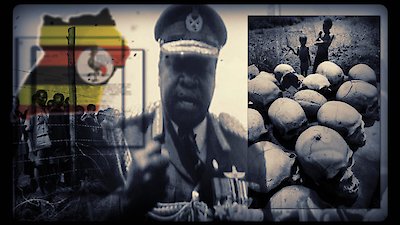
The Dictator's Playbook Season 1 Episode 6 Idi Amin
- TV-14
- February 13, 2019
- 53 min
In this episode of The Dictator's Playbook, viewers will learn about the rule and regime of Idi Amin, the former military general and dictator of Uganda from 1971 to 1979. Through interviews with scholars, historians, and Ugandans who lived through Amin's rule, the episode explores the tactics Amin employed to maintain power and control over his people.
Amin came to power through a military coup, overthrowing the legitimate government of Milton Obote in 1971. Amin, who positioned himself as a charismatic leader, promised to bring stability and prosperity to Uganda, a country that had been plagued by political violence and economic turmoil.
However, Amin's regime quickly became known for its brutality and human rights abuses. He initially targeted his political opponents, but his violence quickly spread to anyone who he perceived as a threat to his power. Thousands of Ugandans were tortured, executed, or simply disappeared under Amin's reign.
The episode explores how Amin used propaganda to create a cult of personality around himself. He portrayed himself as a strong and fearless leader, and his image was everywhere - on billboards, stamps, and even in classrooms. Amin's regime also employed secret police and spies to make sure that no one spoke out against him or plotted against his regime.
One of the most chilling aspects of Amin's rule was his use of violence and terror as a tool of governance. Amin would regularly hold public executions, where he would have his opponents and critics killed in front of large crowds. These executions were meant to instill fear in the population and show them what would happen if they dared to question his authority.
The episode also explores how Amin used his military to maintain power. He promoted his fellow soldiers to key positions in government and rewarded them with money and power. But this also meant that military rule began to dominate civilian life, and the Ugandan people were subjected to martial law and a curfew.
Despite Amin's brutality, there were some who remained loyal to him. The episode speaks with Ugandans who were members of Amin's inner circle, including his former press secretary and minister of finance. These individuals offer insight into Amin's personality and his mindset during his time in power.
Finally, the episode explores the downfall of Amin's regime. As the international community began to pay attention to the human rights abuses in Uganda, Amin became increasingly isolated and paranoid. He expelled all foreigners, including those working for aid organizations, and Uganda's economy began to collapse. In 1979, Amin was overthrown by a coalition of Ugandan exiles and Tanzanian troops.
Overall, this episode provides a sobering look at the regime of a brutal dictator. It offers insights into the tactics used by authoritarian leaders to maintain power, and highlights the importance of promoting and protecting human rights.
